
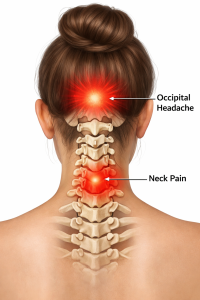
Base of Skull Headaches
One of the most common questions headache sufferers ask is:
“Why does my headache always start at the base of my skull?”
If you’ve ever felt pain where your neck meets your head, you’re not alone. While many people assume the problem is in the head itself, headaches at the base of the skull often originate from the neck, posture, and the muscles that support your head every day.
Understanding Occipital Headaches
Headaches that begin at the base of the skull are often referred to as occipital headaches. The pain may stay in the back of the head or travel into the temples, forehead, or behind the eyes.
Common symptoms include:
- Pain at the base of the skull
- Neck stiffness
- Headaches after sitting for long periods
- Pain that worsens throughout the day
- Tightness in the shoulders and upper back
Many of these symptoms are linked to poor posture and abnormal spinal biomechanics.
Meet the Suboccipital Muscles
Beneath the base of your skull are small muscles called the suboccipital muscles. These muscles help control head movement and maintain balance.
When posture is poor, these muscles work overtime.
Hours spent looking down at phones, working on computers, reading, or driving place constant stress on the upper neck. Over time, the suboccipital muscles become tight, irritated, and fatigued.
This tension can refer pain into the head, creating headaches that seem to come out of nowhere.
How Forward Head Posture Causes Headaches
Forward head posture is one of the most common postural problems seen today.
When your head moves in front of your shoulders, the muscles and joints of the neck must support significantly more stress.
This can lead to:
- Muscle fatigue
- Trigger point formation
- Joint irritation
- Increased tension at the base of the skull
- Recurring headaches
Many people don’t realize that their daily posture may be contributing to their chronic headaches.
Why Desk Workers Are at Higher Risk
Modern lifestyles encourage poor posture.
Whether you’re working at a computer, scrolling on your phone, or sitting in meetings all day, your head is often positioned forward for hours at a time.
Over time, this creates a cycle of muscle tension, spinal stress, and recurring headaches.
Many patients notice their headaches are mild in the morning but worsen as the day progresses. This is often a sign that posture may be playing a role.
Thoracic Hyperkyphosis: The Missing Link
The neck is rarely the only problem.
Many headache sufferers also have thoracic hyperkyphosis, commonly known as a rounded upper back or hunchback posture.
When the upper back rounds forward:
- The shoulders collapse forward
- The head shifts forward
- The neck compensates
- Stress increases on the cervical spine
The result is more tension, more strain, and often more headaches.
Why Your Neck Curve Matters
Your neck is designed with a natural curve called the cervical lordosis.
This curve helps:
- Absorb shock
- Distribute stress evenly
- Support the weight of the head
- Protect the nervous system
When that curve begins to straighten or disappear, the muscles and joints of the neck are forced to work harder. This can contribute to chronic neck pain and headaches.
Signs Your Headache May Be Posture Related
Your headache may be linked to posture if:
- It gets worse after sitting
- It improves when lying down
- You have frequent neck tightness
- You constantly stretch your neck for relief
- You spend long hours on a computer or phone
- Pain starts at the base of the skull
These are common clues that the neck may be contributing to the problem.
How Posture Restoration May Help
Many headache treatments focus on managing symptoms. However, if poor posture is contributing to your headaches, addressing the underlying cause becomes important.
Improving posture may help:
- Reduce muscle strain
- Improve spinal alignment
- Decrease stress on the upper cervical spine
- Support better nervous system function
- Reduce recurring headaches
The Bottom Line
Pain at the base of the skull is often a sign that the structures supporting your head are under excessive stress. Forward head posture, rounded shoulders, thoracic hyperkyphosis, and loss of proper neck curvature can all contribute to headaches that begin in the upper neck.
If you’ve been searching for answers and no one has evaluated your posture, spinal alignment, or cervical biomechanics, you may be overlooking one of the most common causes of recurring headaches.
If this sounds familiar, call Green Chiropractic at 402-933-5392